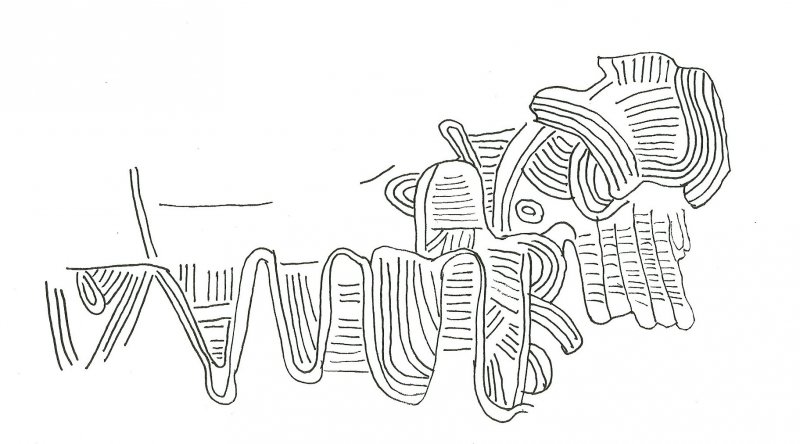
Here, the landscape has been reduced to abstract patterns, where individual symbols have a specific metaphorical meaning: the bends at the bottom symbolize a meandering river, the intricate curves and patterns on the right show the slopes of the Pálava ridge, furrowed with ravines, and the small double circle in the middle marks the position of a human settlement. If this interpretation is correct, it demonstrates a specific vision and expression of space in the Upper Palaeolithic and the oldest known map, in which the hunter’s view into space is rendered schematically, corresponding to the geometric style of their period.
Material: mammoth ivory
Dimensions (length): 365 mm
Exhibit type: copy of original (plaster)
Archaeological site: Pavlov I (Pavlov near Dolní Věstonice, Moravia)
Collection: Institute of Archaeology of the CAS, Brno v.v.i., Czech Republic