Despite Gravettian culture being spoken of as a mammoth hunting culture, it is certain that the people of that time did not just hunt mammoths or other herd mammals. Total dependence on migrating herds would have exposed these hunters to risk of famine, if the herd had failed to appear. Which is why we observe in the composition of the Gravettian diet a definite attempt to include variety, to use the meat of animals that were available year-round and to complement the intake of meat with the consumption of plants.
The composition of fauna species represented at the Moravian Gravettian settlement sites reveals substantial numbers of much smaller animals. Hare were hunted in large quantities; also present were foxes and wolves, providing valuable pelts to make clothes and covers, and to a lesser extent birds and sometimes also fish. Bison and rhinoceros also appear in the bone record, as do dangerous predators and competitor species such as lion, hyena and bear, which having come close to the settlement would either have to be driven away or killed.
Mammoth continued to occupy pride of place, however, on the list of hunted animals – it was the only animal from which it was possible to acquire such quantities of raw material in a single kill. The bones of hunted mammoth were gradually amassed in piles beside the settlement in separate middens. Sometimes they lay in adjacent waterlogged gulches, and at the Dolní Věstonice II site they were even piled beneath the surface of a pond that existed at the time. Dozens of individuals were found at the site; at Dolní Věstonice I they were found in their hundreds.
It has of course been debated whether these waste sites might have been a natural graveyard, a place where the animals came to die, and where humans hunting for bone and ivory turned up only later. Even though this interesting discussion has not been definitively settled, it is clear that life in the settlement was conducted simultaneously with the formation of these middens (→ exhibits 7.1). It is likely, therefore, that the mammoth bones do indeed represent the massive remnants of hunted spoils, which for reasons of space and hygiene accumulated somewhat to the side of the main settlement areas. Storing parts of animal bodies beneath the water may also have been done to preserve food, especially in winter when the water froze solid.
The presence of bones in side gullies also confirms usage of an optimal hunting strategy, which made good logical use of the irregular terrain on the lower slopes of the Pálava. The aim was to separate off an individual animal, preferably a young one, from the main herd, which would have been following the course of river meadows. Once alone, the isolated mammoth would be driven into a ravine and up against a muddy slope of slush. The large creature would be forced to halt by the slippery waterlogged ground underfoot, while the rising sides of the ravine would give the hunter the advantage of height to take aim and strike the mammoth’s most vulnerable places – the belly or eye sockets. Certainly, there was no need to dig a “mammoth trap” – besides, in a landscape of frozen ground that would hardly have been possible.
Mammoth hunting must have been a complicated task, achievable only in groups and requiring co-ordination between a great number of people. The hunt was always connected, therefore, with a certain prestige: the better the haul, the better the hunter. The mammoth hunt must have been a tremendous event within the society, which would have been recounted in stories for a long time after.
Whereas a mammoth hunt was more an occasion for strong and dextrous hunters, equipped with high quality weapons, hunting for smaller animals was less demanding and less dangerous, which meant that women and children could get involved. This method of hunting had little impact on the stone or bone industry, since it only required your everyday stick or club to kill such animals. A net, might also have been handy: marks of knots from a hunter’s net have been preserved on pottery finds. Hunting smaller animals with nets did not even require any special physical strength, experience or even strategy, and in a relatively short space of time it could provide a sufficiently large amount of meat and pelts.
Hunting weapons
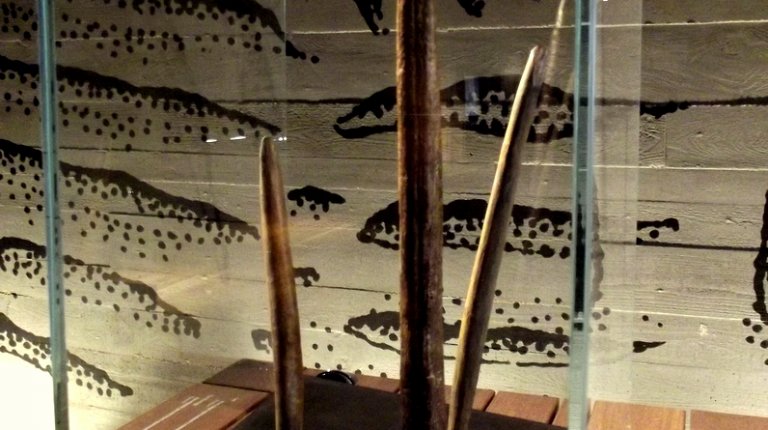
First appearing in the Lower Palaeolithic, the basic hunting weapon was the spear. Originally it was made of wood with a tapered point, sometimes hardened by fire. At Dolní Věstonice II, fragments of elongated wooden objects were exceptionally preserved, most probably spears or their wooden shafts.
During the Gravettian period, the main raw material for manufacturing sharp and solid projectiles that would be fixed to the spear was mammoth ivory or reindeer antler (→ exhibit 5.1). Perhaps it was an ancient hunter’s tenet that to kill an animal it was best to use material from that self-same creature’s own body. The large collection of just such spear points found in the area, ground to achieve a typically circular cross-section, demonstrate that spears with this point were the most frequent hunting weapon during the Gravettian.
Shorter “leaf-shaped” tanged projectiles with a blunt point (→ exhibit 8.3), are also found, suitable for hunting smaller animals and constructed so as not to damage their pelts.
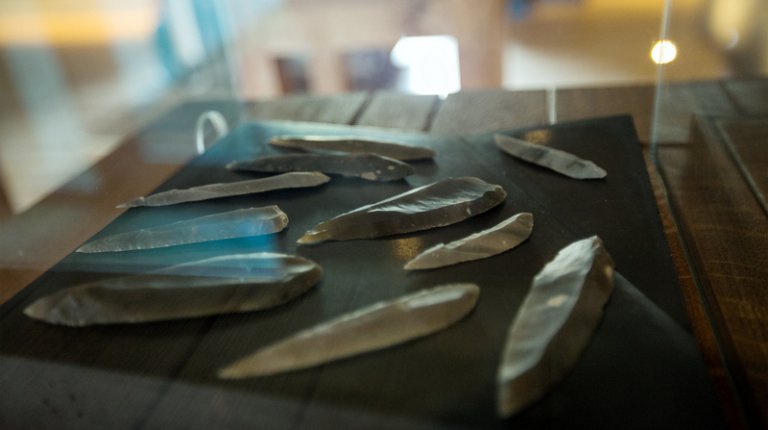
Besides using organic materials to make their points, they also used stone points (→ exhibit 5.2). During the Gravettian period, these were mainly points with one side completely blunted by abrupt retouching and later also points with lateral notches, which in terms of size and shape were certainly attached to spears. Impact traces and breakages that occurred when the fragile stone hit an obstacle would seem to confirm this assumption.
Different forms of smaller-shaped artefacts were also produced in the stone industry, especially geometric microliths, micro points, microblades and saws, whose lightness meant they could be attached to an arrow (→ exhibit 8.2). Therefore, the idea has been proposed that, as early as in the Gravettian period, a new ranged weapon was used alongside thrown weapons – the bow.
It is much more likely, however, that these micro points were set in continuous rows onto a spear or harpoon. By using variously shaped microliths in this way, even very complex types projectile heads could be created which would otherwise be impossible to produce. These stone micro points are found in great number on our sites, but not one single example of an arrow-shaft or a combined spear has been preserved, so any ideas on this matter must remain lodged in the realm of pure hypothesis.
Use of vegetation
Plants were used by people to make textile fibres and were also, of course, hunters’ second major source of nutrition. As an omnivore, the human diet did not consist solely of meat. Feeding young children on a diet exclusively of meat would have been particularly problematic, but adults too required nourishment from more than just meat. The use of vegetables in the diet is difficult to demonstrate, however, as archaeological methods are unable to secure sufficient direct evidence.
The steppe and tundra landscape across which our mammoth hunters roamed offered numerous edible berries and seeds that could have been collected. At the Dolní Věstonice II site, British palaeobotanists found traces of crushed vegetable fibres in one of the hearths and interpreted the find as the remains of porridge, perhaps in a child’s faeces.
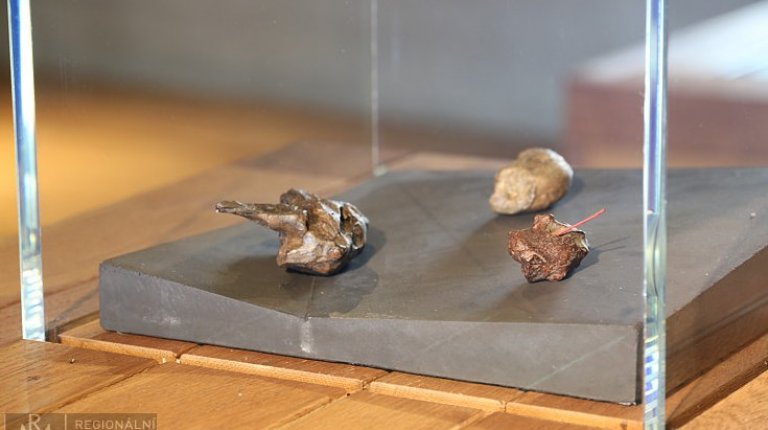
At the Pavlov VI site, and most recently at Dolní Věstonice I, Italian colleagues documented on two grinding stones remains of crushed vegetable fibres – microscopic traces of starch grains. Our digs have also produced a large number of stone slabs, used primarily to crush mineral pigments (→ exhibit 9.4). We can suppose, however, that such stones or equivalent flat pieces of rock were also used to crush plant food.