Present-day research prioritizes a contextual approach to art and symbolism, as being an integral part of the social and psychological systems of the past. It lays particular emphasis on the role of symbols in human communication, i.e. in the exchange and retention of information.
The very oldest artistic expression appears in Europe during the Upper Palaeolithic and corresponds with the arrival of anatomically modern humans. Thus it seems that the genesis and development of art is related exclusively with our, i.e. modern human, population from whom – in contrast with earlier types of people – we can expect a difference in approach to the environment, which for modern human beings can be linked to the formation of a more integrated architecture of thinking.
From an evolutionary perspective, art appears suddenly as if “fully realized”, technically and stylistically perfect with a complete variability of form – wall paintings, carvings, sculpture and decorations. A linear scheme of progression (from “primitive” to “complex” and then to “perfect”) does not apply here. Palaeolithic art produces formally perfect works right from its very beginnings, during the Aurignacian culture more than 30,000 BP. Then we see, for example, the cave paintings from the Chauvet Cave in France or the animal, human or half-animal, half-human statues carved in ivory and stone found in caves along the Danube in Germany. Later, during the Gravettian period between 30,000 to 20,000 BP, appears a large quantity of formally and technologically disparate assemblages of art objects from Moravian archaeological sites (especially zoomorphic and anthropomorphic statues and carvings), chronologically followed by stylistically related artefacts from Italy, the Ukraine and Russia. Subsequently, over the next ten thousand years during the Magdalenian period (18,000 to 13,000 BP), there appeared most of the cave painting in the West-European caves, which is when the flowering of Palaeolithic art reached its zenith.
At the beginning of the 20th century Pablo Picasso, Joan Miró and other founders of modern art realized that the cave paintings in France and Spain were, despite their age, already perfect in terms of form and subject matter. “We have invented nothing new”, Picasso is alleged to have said, and his bulls or Miro’s symbols seem to corroborate that claim. The famous French archaeologist Henri Breuil argued something similarly anachronistic, “…the paintings have both – elegance and strength …their aesthetic concept reminds us of the early Renaissance…”
Art is part of a system of thinking and behaviour which is conditioned by consciousness and a definition of time and space. Time itself creates the dimension in which symbols over the long-term can be realized. This timeless quality of artistic artefacts can express itself in various forms of art, which can be referred to as “short-lived” or “long-lived” – according to the length of times these artefacts are used and their meaning is preserved. Short-lived symbolic artefacts serve their purpose only in one specific act, ritual or game; once the activity has been completed, the artefact is deprived not only of its meaning but its importance, too. Belonging to this category are statues made in wet clay, modelled, remodelled, fired and in no time at all thrown away again, fleeting engravings on a stone slab, subsequently drawn over with a new theme, and certainly drawings inscribed the sand or painted on the human body. The second group of artefacts consists of those that remain in long-term use, carried or repeatedly seen – laboriously ground amulets, decorated tools and weapons.
Animals and people seen through the artwork of mammoth hunters
A thematic breakdown of the zoomorphic subjects reveals that powerful, dangerous or simply striking-looking animals predominated in Palaeolithic art. This was not simply ordinary hunting magic, i.e. portraying those creatures that would be hunted and eaten. Rather, we can link the chosen animals to certain impressive characteristics like strength or size, as well as composure, courage or agility. On the basis of these qualities animals enter a cosmological system, into rituals and probably also (→ exhibit 11.9) into mythological stories about which we can only speculate.
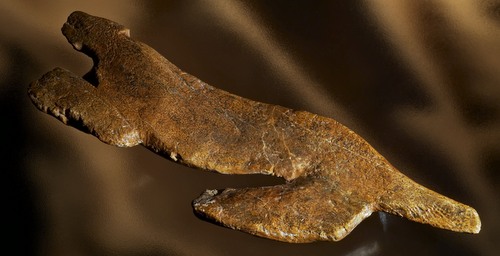
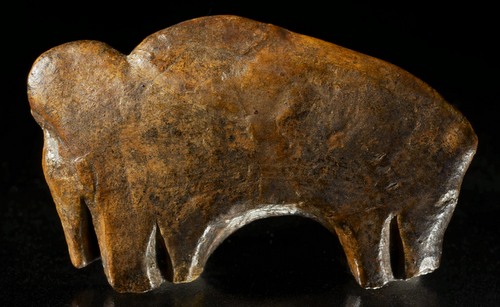
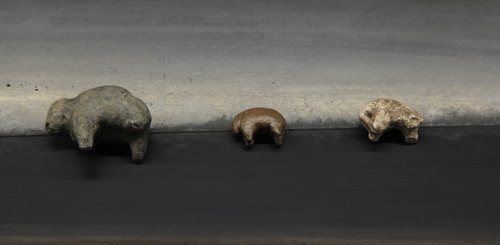
The very Pálava themselves, visible for far and wide, even today with their shape remind us of some prostrate creature, maybe even the mammoth (→ exhibit 11.8) that prehistoric people once would have encountered here. Hunters repeatedly modelled the shape of mammoths into clay and also carved them in flat tablets of mammoth tusks. Artists conferred similarly great importance on the lion (→ exhibit 11.7). Other animals – inhabitants of the landscape at that time – followed, for example the bear, rhinoceros, reindeer and Alpine ibex. Hares and foxes, with whom hunters came into daily contact and whose bones have accumulated in large numbers at our settlement sites (perforated fox teeth were commonly used as ornamentation), were not depicted at all.
The portrayal of human beings is much rarer in Palaeolithic art compared to that of animals. Also the fact that the motif of women is much more prevalent among anthropomorphic subject-matters is sufficiently well known, and is certainly conditioned by the fundamental, biologically natural attractiveness of the theme (→ chapter 10 Venuses). This of course does not mean that the motif of manhood is absent or was in some sense taboo. One of the most remarkable finds with this motif is the large carving of a male figure in ivory with relatively distinct facial features and which consists of several parts – seemingly like a puppet → exhibit 10.1). It comes from the ritual grave of a man discovered in Brno on the site of the modern street Francouzská (Brno 2 site), and surely is related somehow to the deceased who, considering the wealth of grave goods, must have been an important individual, gifted with organizational or shamanistic abilities.
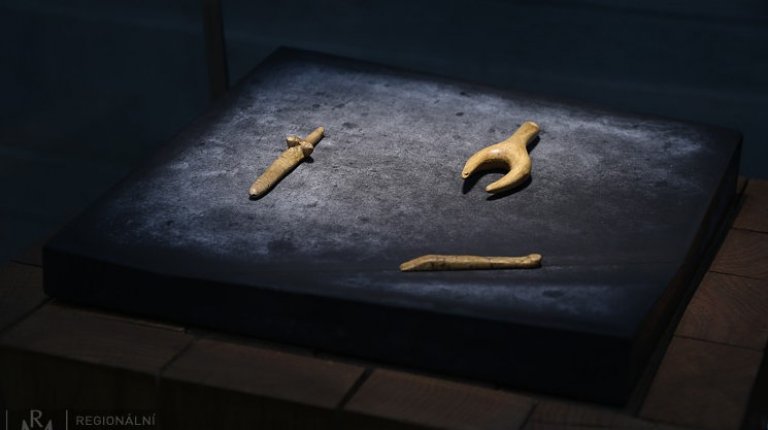
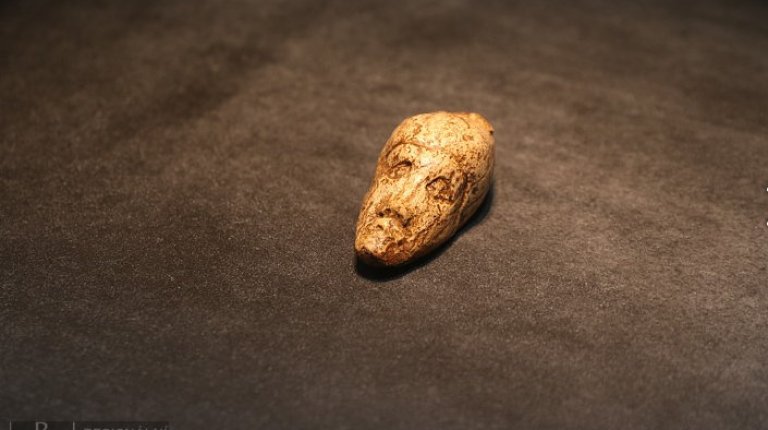
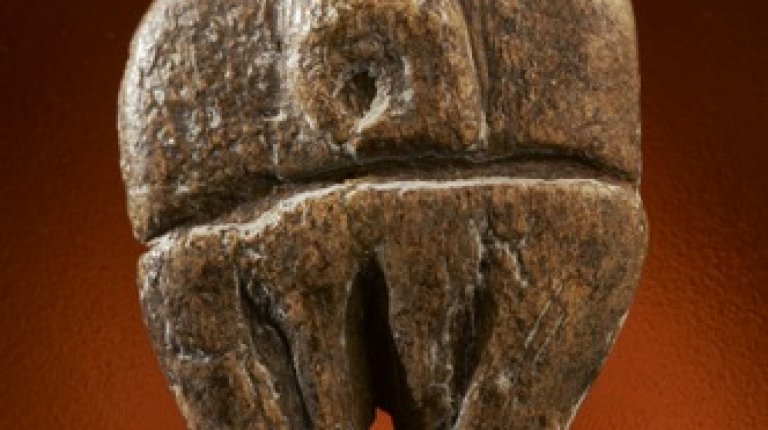
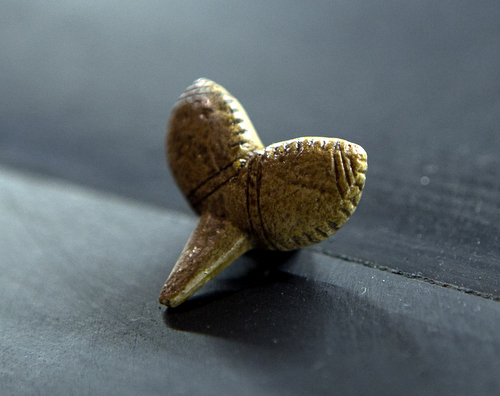
Of the female figures the uncontested queen is the Venus of Věstonice (→ exhibit 10.4), which is one of a group of Gravettian Venuses distributed over a wide Eurasian area (→ Chapter 10 Venuses). The archetypal form of the Venus of Věstonice is shared by several other, lesser-known female figurines from this area. People played with the idea of the female form. From clay or ivory they created not only whole figures, but also abstract shorthand forms of the human body – independently conceived bosoms, heads (→ exhibit 11.1) or the triangular form of a woman’s crotch (→ exhibit 11.5). However, looked at differently, it is also clear that within this symbol is encoded the male principle. The thinner stick-like figure with breasts is then naturally transformed into a symbol of male genitalia (→ exhibit 11.2). This game of forms is primarily played out at an abstract level, the forms do not refer to specific men or women.
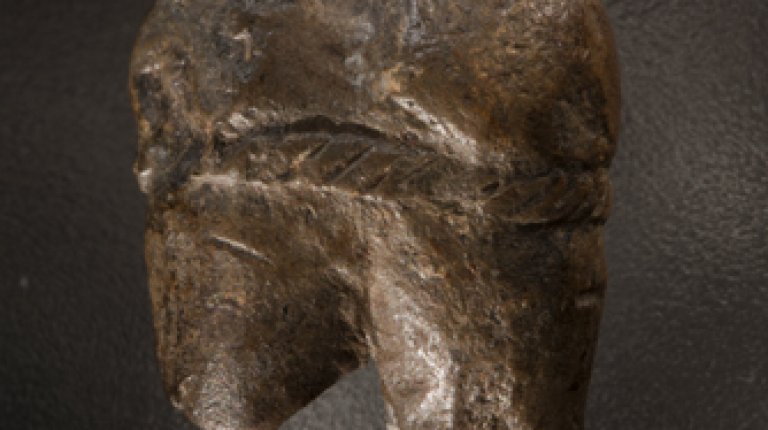
In fact, a certain anonymity of the anthropomorphic subject is somewhat characteristic of Palaeolithic art – the head tends to be reduced, made more geometric, sometimes caricatured or even deformed, for example, a spherical shape covered in a series of protrusions, reminiscent of grapes or a woven basket and an almost mushroom-like bicone shape. And yet nonetheless, Dolní Věstonice and Pavlov do provide figurines that stand apart from the anonymized majority, partly as a result of individual physiological features, partly due to their clothing accessories - a detailed and elongated face of a woman, with obliquely outlined lips, crowned by substantial headgear or hairstyle (→ exhibit 11.1), a crudely carved mask with a similarly striking asymmetrical mouth or, in the case of the aforementioned clothing accessories, the bands or belt-cords encircling the torsos of some female figurines (→ exhibit 11.6).
Decorations and decorative samples
The world of Palaeolithic art also encompasses the living person, adorned with decorative objects and sometimes painted, tattooed or wearing ornamental clothing, which of course may be pure conjecture.
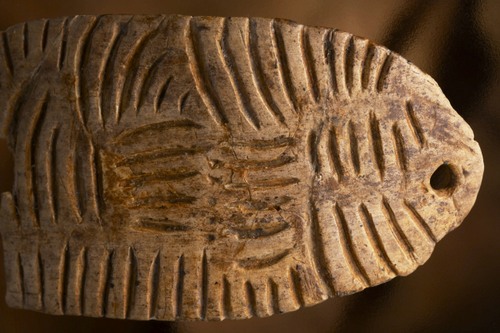
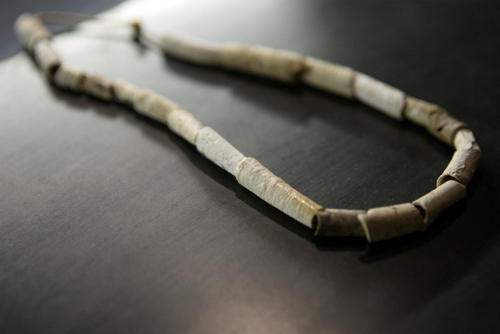
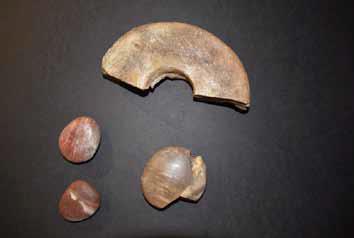
At a period when the first modern humans in southern Africa and the last of the Neanderthals in Western Europe were perforating items and creating simple decorations, the mammoth hunters of Dolní Věstonice and Pavlov had an entire array of decorative items. While many were inevitably fashioned from naturally occurring objects, such as the cuspid teeth of predators (→ exhibit 9.2), the shells of fossilized tertiary invertebrates (→ exhibit 11.13) or everyday pebbles, other items used scarce and difficult to work mammoth ivory. This group included delicately and precisely carved little pearls, appliqué and curved oval diadems, which were then covered with geometric patterns. Also carvings in the form of people or animals were fitted with notches or openings so that they could be suspended from some cord or attached to clothing (→ exhibit 11.12).
Gradually, a wide spectrum of shapes crystallized, apparently with specific types of significance. Using parallels from ethnography, we can assume that the purpose of such items was not simply decorative, but to carry information about their wearer, his or her origin, status, characteristics and achievements. In those cases where decoration was worn in a visible place, the information may have referred to ethnic affiliations.
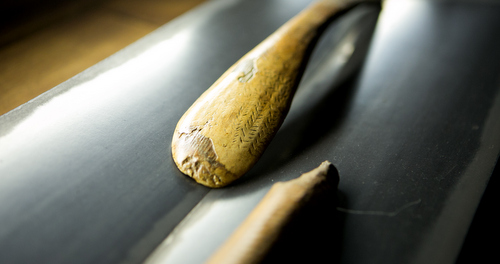
Additional informational value might also have been conveyed by the typical geometric patterns (→ exhibit 11.10) that fill up the available space on decorative items, tools and weapons. By comparing these decorative patterns during the Moravian Gravettian, we can see that certain décor may be characteristic for an entire archaeological site, or network of sites. A basic decorative scheme is standardized at all of the main sites (Dolní Věstonice I, Pavlov I and Předmostí I) – twig-like ornaments (→ exhibit 11.11), hatched triangles and arcs – only the shape of the line differs: it is slightly more crooked in the Pavlov finds, straighter for those from Předmostí. Attempts to grasp the sense and hierarchy of these patterns are hampered by a lack of contextual information about the societies of that time. It would be necessary to know not only the metaphor encoded in these pattern, but also the function of the items themselves, the activities in which they were used and the social status of their users. Such information is missing from the archaeological record. One definite conclusion can nonetheless be made – the outwardly characteristic decorative style of the Gravettian expressed the social unity of this hunting population and also the consciousness of that unity.
In relation to decorative adornments, the find of a mammoth tusk with complex, engraved geometric ornamentation, is also important. This was excavated by Bohuslav Klíma at the Pavlov I site and has been interpreted as a map of the Pavlov Hills (→ exhibit 1.1). The landscape has been reduced to abstract patterns; the hunter’s view of the area is schematic, drawing on the geometric style of the era and imbuing individual symbols with specific metaphorical meaning – meanders of the river, slopes of hills and a small double circle as a symbol of a human settlement. If this interpretation is correct, then it is evidence that people of the Upper Palaeolithic were capable of depicting space.
Besides complex geometric ornamentation, another type of record emerges from the inscribed patterns – the regular arrangement of the very simplest symbols, i.e. linear scratches in stone and bone (→ exhibit 8.6). These rhythmically repeated parallel rows of short scratches or nicks, as well as deeper notches, can be interpreted as counting records, carrying information about quantities of hunted game, for example, or as other records for measuring time according to the lunar cycle. This would mean not only that people were conscious of time, but could measure and record it.
One example is the radial bone of a wolf (→ exhibit 8.5), which was found by Karel Absolon in 1936 at Dolní Věstonice I and was even interpreted at the time as an aid to recording numbers – a “counting stick”. Along virtually its entire length the bone is covered with short crosswise scratches – in the upper part are engraved 30 of them, 25 are lower down, with the thirtieth and the twenty-fifth scratch extended right across the width of the bone as if representing clear dividing markers. A similarly engraved bar, this time made of stone, with regularly arranged lines was discovered by Bohuslav Klíma at Dolní Věstonice II (→ exhibit 8.4). Despite the fragmentary nature of the artefact, he identified a series of scratches, in groups of 5, 5, 7, 7 and then 5 more nicks, i.e. 29 scratches in total, and interpreted the artefact as a lunar calendar.
Rituals
Most artistic artefacts were probably linked to the spiritual ideas of the people of that period and their symbolic world. The assumption is therefore made that the artistic expression of the mammoth hunters was closely connected to the performance of various types of ritual that reflected their attitude towards the world, their knowledge or ideas about it. By referencing the ethnology of today’s fourth world tribes, we can presume that some of these rituals were connected with female fertility, motherhood, birth, initiation into the community, hunting, death and with the individual seasons of the year.
Unlike the simple recounting of tales, performing a ritual places much greater demands on society and takes up more of its resources. If a ritual is to be demonstrated through the application of archaeological methods, then certain situations, the overall context and its interpretation will gain especial significance. In Moravia, practically all traces of ritual, whether that means the torsos of ceramic figures, or graves, are concentrated in the central parts of settlements or in “places of the mystic cult of the hunt” as they were described by Karel Absolon. Today, it is possible to state that at the sites of Dolní Věstonice I and Pavlov I, these artefacts are even concentrated inside particular structures. This indicates the social function of rituals, which were conducted in spaces where everyday life took place.
Technological analyses of the ceramic figures from Dolní Věstonice and Pavlov, and especially their fragments, has demonstrated that they were somehow intentionally damaged and destroyed here, whether mechanically, for example by being punctured with a sharp object, or by exposure to a sharp temperature change by firing (→ exhibit 5.3). Behind such acts can be sensed some kind of narrative, and indeed ancient literature has a pre-prepared answer – hunting magic. The ritual destruction of an image would appear to be equivalent to killing the animal itself, and that between the two actions lay a causal relationship. If we now take a look at the species of animal depicted, however, we find a definite paradox, one that is identical to that observed across the whole of hunting art, from Cantabria to the East European Plain – the artistic theme is dominated by large, dangerous or otherwise impressive creatures. The smaller animals, which constituted the real, reliable staple foods, are virtually absent from the art. Thus the narrative hidden behind these rituals will probably more complex, perhaps more symbolic and mythological than would appear at first glance.
Ritual manifestations may also be connected with another of peculiarity of Palaeolithic figurines, especially Venuses. Some, if not perforated directly, have grooves on their bodies allowing them to be hung symmetrically, or enabling them to be moved remotely, and with the help of light and shadow play this might have been a means for their inclusion in ancient rites, Such practices could well have been a south Moravian analogue to the rituals thought to have occurred in the depths Western European caves. The contoured carvings of a lion (→ exhibit 11.7) or mammoth (→ exhibit 11.8) may also have been used in such a shadow play.
Among the artefacts ascribed ritual or symbolic significance are also the special discs ground from marlstone slabs, with a perforated opening in the centre. A fragment of such disc was found at Pavlov I (→ exhibit 11.14), while whole pieces come from the site at Předmostí and from the male burial at Brno 2. The function of these artefacts remains a mystery, but the likelihood that they had more spiritual meaning than practical application is suggested by the absence of any evidence of work on their surface, as well as knowledge of similar such items used by Siberian shamans or else their being found in Asian art.
Pigment too may have had ritual use and significance, especially in relation to hunting burials, where red pigment generally covered the skull, pelvis or even the entire body of the deceased (→ chapter 9 Burials).