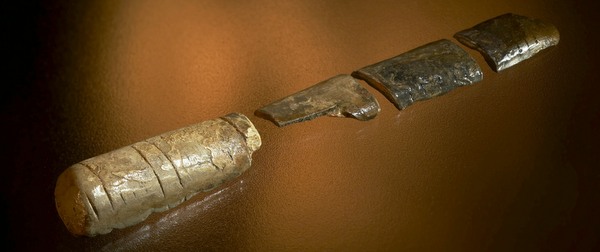
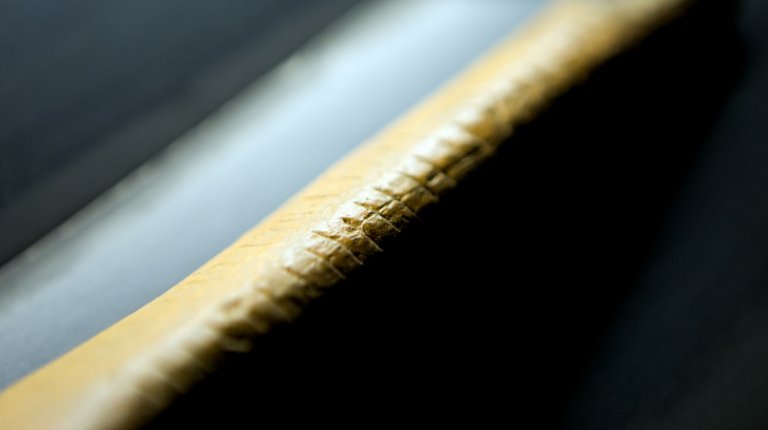
The carefully considered use of food and raw material resources meant that it was possible in some areas, for example in the settlement area of Dolní Věstonice – Pavlov – Milovice, to establish the first quite stable, almost permanently inhabited sites (Pavlov I, Dolní Věstonice I), where a more settled way of life is reflected not only in the settlement’s structures, types of dwelling and everyday necessary items, but also in the aesthetic and artistic expression and the development of new, more advanced technologies (ceramics, textiles, ground stones). Despite the fact that people seemed to have lived in the larger settlements all year, the yearly cycle was certainly dynamic, and groups of hunters would have seasonally set off to other hunting grounds in search of their quarry and raw materials. Smaller sites were probably inhabited only seasonally.
Settlement and Dwellings
If we ignore specialized and single-purpose sites (e.g. mammoth middens or places for butchering and processing the haul), then the basic feature of most Gravettian settlement sites is a settlement unit containing one or more hearths and various kinds of depressions in the terrain, characterized by the accumulation of larger objects around the perimeter and a corresponding concentration of artefacts. This type of unit has been interpreted as a dwelling, inside and around which was centred the entire living and working space. A large hunting site like Dolní Věstonice or Pavlov, for example, would have been made up of several settlement units, although they may not have all existed contemporaneously and thus create a single village.
The ground plans of individual dwellings (→ exhibit 8.7) are not always possible to archaeologically interpret, and only in rare cases do we find deposited around the circumference a clear circular alignment made of stones or large bones. The diameter of such units tends to be uniform – about 5 metres. The reconstruction of huts made from wooden supports and a leather covering, carried out above such ground plan, is derived from the shapes and building techniques tried and tested for thousands of years in the cold, sub-Arctic regions of North America and Asia. Such a structure (teepee, yurt or chum) must have a simple yet strong design, must be easy to heat, must be wind-proof and be ready to withstand the weight of a heavy covering of snow.
Based on the archaeological findings (on the presence of the relevant settlement structures), four basic types of structure can be distinguished at the Gravettian settlements. The first is a light, although stable, dwelling with a wooden yurt-type construction, covered in hides; the freezing solid of the covering during winter would have definitely strengthened such a structure. The possibility has also been considered that clay was daubed across stick or bone structures to seal them.
The second, relatively specific type, is a building whose circumference is lined with a circle of mammoth bones that would stabilize the structure against gales and thus be very suitable for the steppe environment at a time when the climate was gradually worsening. The first complete perimeter for such a dwelling, up to 8 metres in diameter, was discovered in the upper part of the Dolní Věstonice I site and a similar structure was also excavated at Milovice I. The best structures of this type are known from Eastern Europe (Mezhyric and Mezin sites), where the mammoth bones were not only used to create the foundation kerb, but to create the building shell itself.
The third kind of dwelling was typified by having a slightly sunken ground plan, circular to oval in shape and between 4 to 8 metres across. They are always equipped with one or more hearths, and along their perimeter they are only sometimes, and always irregularly, lined with larger objects (e.g. buildings 1, 3, 5, 8, 9 at Pavlov I or building I at Dolní Věstonice I). The base of these structures was sometimes irregularly divided by shallow bowl-like and cauldron-like pits. These were a more light-weight type of dwelling, more a seasonal tent that would not have been able to cope with too much wind. The elements that formed its load bearing structure have not survived, so it is highly likely that the material used was something that is difficult to corroborate archaeologically, namely wood. This wooden structure would then have been covered with hide.
The last type of structure represents a hearth in a flat terrain without any sign of perimeter demarcation. The hypothetical roofing in this case must be reconstructed on the basis of “latent” structures, derived from how the artefacts are scattered, which in certain cases create a characteristic pattern, for example circular shape or the so-called “barrier effect”, when items gather up against the walls of the hypothetical dwelling.
Palaeolithic household – hearths and boiling pits
A marked variability in size and type of hearth is characteristic for the Moravian Gravettian. The fine stratification of carbonaceous layers in a numerous cases indicates the repeated reuse of hearths. Bohuslav Klíma in some cases even speaks about ovens, and although in general it is not supposed that hearths were entirely spanned with any arch structure, it is clear that the edges of hearths were to a certain height encircled by a clay bank. A section of fired lumps had crumbled away from just such a construction or from the original clay infill of an oven structure. The assumed usage of ovens might also be demonstrated by the small channels feeding air into the hearth (Dolní Věstonice I), the bowl-shaped pits – maybe for removing ash at the lower edge of the hearth (Dolní Věstonice II) – and also the stones that served as thermal batteries to prolong the hearth’s heat-giving properties (Dolní Věstonice II). For fuel they used wood, in some places also mammoth bones, and at Petřkovice u Ostravy it was shown that even black coal was burnt.
At Dolní Věstonice II, shallow bowl-shaped hollows repeatedly huddle up against the hearths. These hollows might have been used for disposing ash and perhaps for cooking in it. Also nearby tended to be a circle of cauldron-shaped pits, spaced roughly a metre apart, which most probably had something to do with the activities of a Palaeolithic kitchen and are interpreted as a boiling pit – substituting the need for kitchen cooking utensils. The method of boiling using pits is known and also used today by sub-Arctic Native Americans and Eskimos: a pouch containing water, perhaps with crushed bones, is placed in the pit and brought to the boil by dropping in stones from the nearby hearth.
Number of inhabitants
Taking into account their exploitation of the surrounding landscape, it is not assumed that the hunter population density would have been great: it ranged between 2−10 individuals per 100 km2. If we calculate the territory of the Mid-Danube Plain and surrounding low hills as an area of 250 000 km2, then the hunting population may have reached 5,000−25,000 inhabitants. This figure is roughly comparable with the number given for the original Native American settlement across a similarly large region of modern Canada.
It is assumed that one hut could have housed on average about ten inhabitants. Demographic estimates for long-term inhabited hunter settlements based on their size and structure is problematic, however, because it is generally impossible to estimate with certainty how many of the huts standing in one place were contemporaneous. If we are to assume that the very largest settlements contained between five and ten such dwellings, then the numbers of inhabitants might temporarily have risen to 100 people – for example during a joint hunt, the subsequent processing of their haul, or during the course of celebrations or rituals. For hunters and gatherers this is a large number of people, but for organized activities it would have been an appropriately sized group. During the hunt and processing of bison on the American prairies during the 19th century, for example, Native Americans assembled in groups of 50−100 members.
Oldest ceramics
The Moravian sites provide evidence for the earliest manufacture of ceramics in the world. The largest collection of such artefacts comes from the large complex of settlements at Dolní Věstonice I and Pavlov I, where in addition to the accidentally fired fragments of clay which had formed the walls of the hearth or the structure of the dwelling, were also found fragments of modelled figures, most often of animals, but also of people. The Venus of Věstonice is also made of fired clay (→ exhibit 10.4).
Some of the ceramic figures were deliberately damaged immediately after they had been modelled, documented by traces of violent incision, puncture marks made by sharp objects or deformation by temperature shock whilst firing (→ exhibit 5.3). This destruction was probably related to some ritual behaviour and the symbolic function of such artefacts. With this in mind, the discovery of the remains of a dwelling at the Dolní Věstonice I site is interesting. The hut was some way from the settlement, slightly sunk into the slope and containing a large hearth around which were found more than 2,000 modelled fired lumps of clay as well as fragments of figures.
The principal raw material for making ceramics was local loess, fired at temperatures of between 500–800 °C. The specific situation of the terrain at the Dolní Věstonice excavation shows that helping to achieve such heat might be the small channels for feeding air, the rim of the hearth raised in the style of an oven, or even just stones placed into the hearth as heat accumulators.
First textiles
Fragments of fired clay have the ability to preserve on their surface the prints of organic substances and structures that would otherwise not have survived. Examined under a microscope, it is possible to find on these ceramic lumps various types of prints – fingerprints of adults and children who touched the still damp clay before firing, traces of plant materials, animal hairs, as well as crossed fibres corresponding to the structure of woven textiles. Detailed examination of these prints has made it possible to differentiate several types of weave: prints of braided cordage, knots and nets have all been recognized.
The largest of these clay lumps are only the size of a fingernail, and so there is little solid idea how these textiles looked, how big they were, and what exactly they were used for. They could have been different clothing accessories (hunters certainly did not stop using their tried and tested furs as the basic raw material for making clothes), delicate matting perhaps, woven baskets, and in the case of knots – these could well be nets, just like those often used today during the hunt for smaller mammals and when fishing.
The manufacture of textiles required a series of implements – a simple frame, weights and weaving tools. Weavers were probably using plant fibres, from nettles for example, which in the ethnographic record in Europe has the best documented tradition and which are found in the pollen spectrum from Dolní Věstonice II.
The discovery of prints with a textile structure proves that knowledge of these technologies is several thousand years older than was formerly believed. Moreover, these finds testify to highly developed procedures for textile manufacture: these are not simple “first attempts”. Despite the fact that the earliest find of plant fibre has recently been announced in Georgia, the prints of textile structures at Pavlov are the oldest of their kind anywhere in the world.
Stone grinding
The technique of stone grinding is generally associated with the Neolithic. However, at Dolní Věstonice and Pavlov several stones had been deliberately ground, and knowledge of this skill is one of the technological firsts of the Moravian Gravettian. At Pavlov, this is evidenced by pebbles of white limestone, marbled with a red siliceous substance and colourful patterns (→ exhibit 11.15), which surely had some aesthetic importance, although generally they were used as retouchers and hammerstones. At Předmostí, in the Brno 2 burial, or at Pavlov I, they again found special ground marlstone discs with a central perforated opening (→ exhibit 11.14). Their function still remains a mystery – although they are generally ascribed a ritual or symbolic meaning. The regularity of the ground surfaces and perforated openings are testimony in any case to a mastery of technique and a high level of technology.
Use of plants
People in the Gravettian used plants partly for manufacturing textile fibres and partly as one of the main sources of nutrition. Humans, as an omnivorous species, are unable to survive on an exclusively meat diet – children in particular would face difficulties on such one-sided nutrition, though adults too would find a carnivorous diet nutritionally deficient. However, the use of plants is hard to substantiate due to lack of direct evidence produced by archaeological methods.
The steppe and tundra landscape across which the mammoth hunters roamed offered numerous edible berries and seeds that could have been collected. At the Dolní Věstonice II site, British palaeobotanists found traces of crushed vegetable fibres in one of the hearths and interpreted the find as the remains of porridge, perhaps in a child’s faeces. At Pavlov VI, Italian colleagues have very recently documented the remains of crushed vegetable fibres on one of the large grinding stones. Our digs have also produced a large number of stone slabs, used primarily to crush mineral pigments, though it is also fair to assume such stones or equivalent flat pieces of rock were also used to grind plant food.
Stone as a raw material
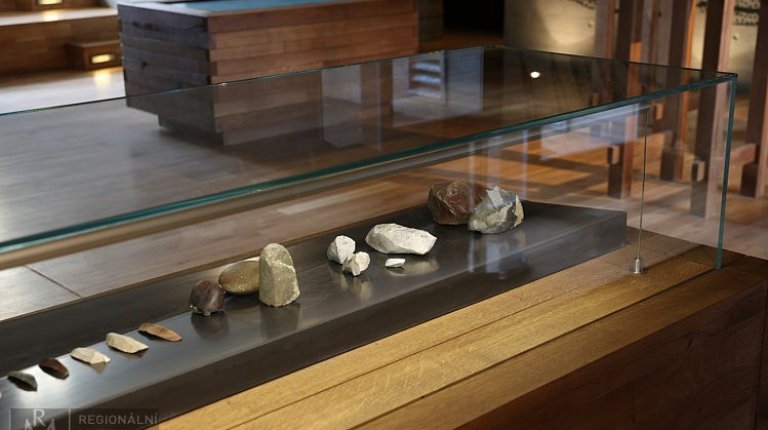
The basic raw material for the manufacture of tools in the Palaeolithic was stone – from the technological point of view, several different special types of easily fissile silicities such as flint, radiolarite and other forms of chert or quartzite (→ exhibit 8.1).
The Moravian Gravettian is characterized by specialization in certain forms of minerals. Mammoth hunters essentially ignored the local sources of raw materials (local chert and quartzite) and created a unique supply model based on importing distant, although high quality, colourful types of silicites. The distance ranged from 100-200 kilometres. The predominant material was flint (which made up 60-90 % of all silicites), which was transported to the south Moravian Gravettian sites from where it occurs naturally to the north – from glacial sediments and primary outcrops in northern Moravia, Silesia and southern Poland. Other widely used materials were the reddish-brown and green radiolarites coming from the White Carpathians region on the Moravia-Slovakian border or from the Danube Plain (northern Alps).
Transporting large quantities of stone probably formed part of the regular seasonal expeditions to the northeast, which may have coincided with the migration of herd animals. This idea is supported by the very modulation of the Moravian-Silesian territory – the positioning of the river basins oriented in a north-westerly direction and the distribution of Gravettian settlements at almost regular intervals along the axis of the supposed movement of expedition parties, and finally even the possibility of making the journey easier by taking to some of Moravia’s rivers.
Sporadically, even truly exotic materials have been discovered at south Moravian Gravettian sites, such as obsidian or crystal, which may also indicate the occasional exchange, trade or offering of gifts between members of different communities.
Local materials gathered from the immediate surroundings, primarily from the gravel beds of the Dyje River, were used for manufacturing cruder tools and constructing dwellings and hearths. Tertiary deposits close by the settlements offered up shells of fossilized molluscs that were partly used to make decorations or as small bowls for applying pigment, and partly as a basic mineral pigment for shade of red, brown, and yellow, which the hunters would no doubt have supplemented with other pigments brought from much further away.
Manufacturing stone tools
At the beginning of the technological process of manufacturing chipped stone tool artefacts was a nodule of raw material, a blank, which by chipping off surface flakes was fashioned into the shape of a core; in the Upper Palaeolithic these had typical shapes with a characteristic leading edge. Once the core was prepared, the next stage was to strike the so-called striking platform in the direction of the guiding edge to remove regularly shaped flakes or blades (→ exhibit 8.1).
To strike off a flake or blade and also for retouching, either a hammerstone or stone splitter was used (hard hammer stone percussor) or an antler or bone tool (organic hammer percussor). As the core was knapped away to produce flakes, the length of blades would decrease in size, since the striking platform often needed frequent reworking, until the core was completely exhausted. The residues of cores and various microcores would remain, which could then be used as hammerstones themselves, which is often demonstrated by the frequent percussion marks on their edges.
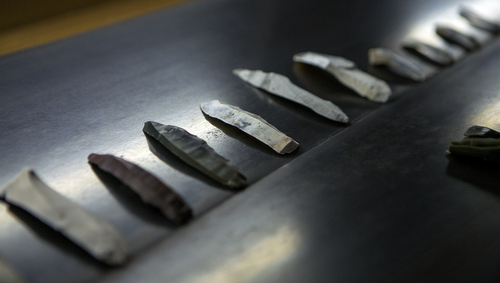
The chipped off blades and flakes could either be used straight away as a functional tool (e.g. for cutting), or could be further reworked, especially by delicate retouch of the edges, to create various types of tool. Typical for the Gravettian were points (→ exhibit 5.2), various burins, scrapers and retouched blades, as well as side scrapers, chisels, denticulate tools (notched), borers etc. (→ exhibit 8.2). A special characteristic feature for the south Moravian locality was the manufacture of very small stone tools, namely microliths – microsaws, microblades and especially geometrically shaped items (segments, trapezoids and triangles). The majority of manufactured tools were hafted onto a wooden, bone or antler shaft.
At the other end of the typological spectrum of stone tools is the so-called “heavy-duty industry”. These are artefacts predominantly manufactured from local, lesser quality materials (quartz, limestones, sandstone etc.), which were employed for rougher work – like choppers, plaquettes, retouchers, hammerstones, grinders, plaquettes for grinding mineral pigments etc. (→ exhibit 8.1,)
Bone industry
Running parallel with the manufacture of stone tools was the development of the bone industry. Processing bones, antlers and especially mammoth ivory represented a difficult technological process requiring the use of various techniques such as striking, grinding, cutting and drilling, often followed by decorative work on the tool surface. Thus, during the Gravettian was developed a wide range of various types of objects (→ exhibit 8.3) – from the decorative, symbolic and ritual through to work tools and weapons. In particular, precision work with mammoth ivory reached technical perfection during this era, with articles being manufactured at a truly miniature scale – decorative pendants, beads, appliqué and carvings (→ exhibit 11.12).
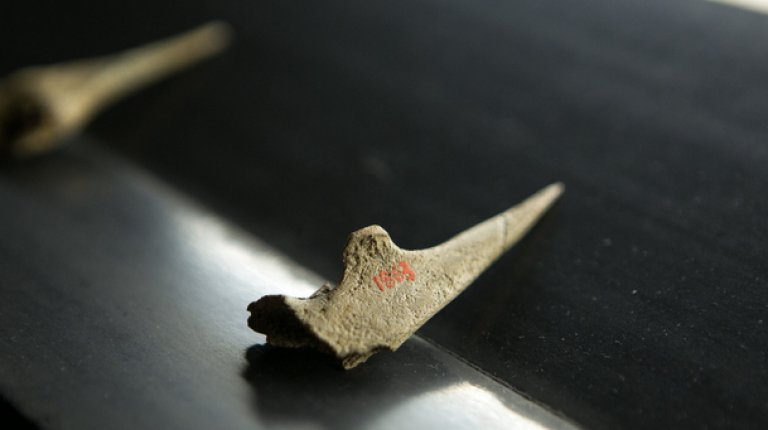
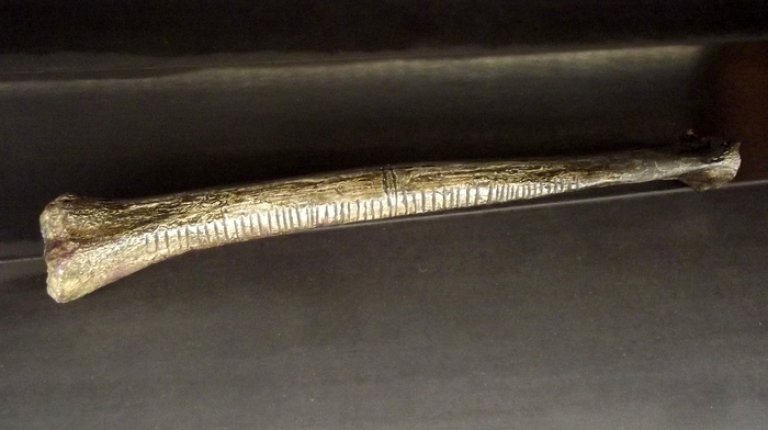
Among everyday bone implements are bodkins of all shapes and sizes – the finest of them functionally foreshadow needles, also there are different awls, daggers, trowels/smoothers (bluntly terminated flat sticks, often worn smooth until shiny) and picks for digging, made from reindeer antlers (→ exhibit 8.3). Typical Gravettian bone tools also included spoon- and shovel-like tools – spatulas, markedly different in size and shape and which likely had diverse functions (shovels, clubs, blunt projectiles, smoothers etc.). Some of these have their entire surfaces decorated with carved geometrical ornamentation (→ exhibit 11.11).