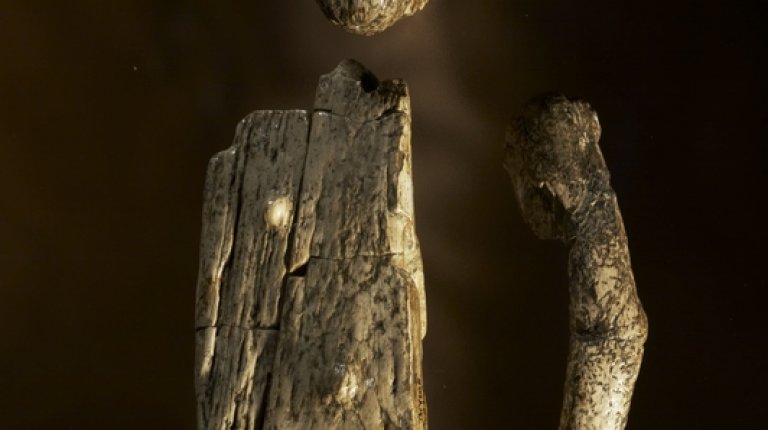
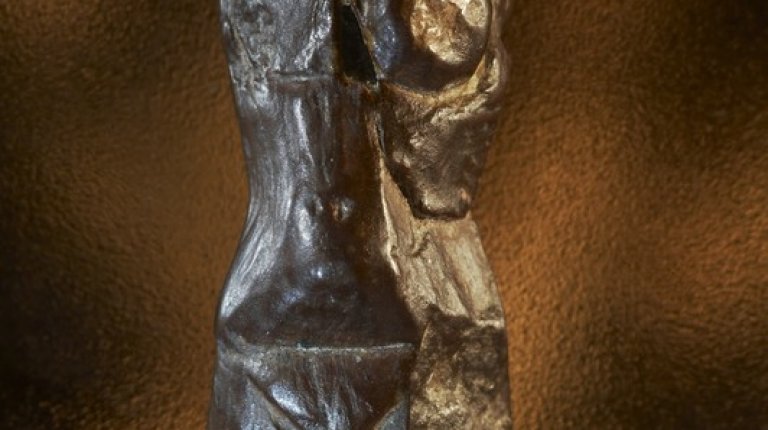
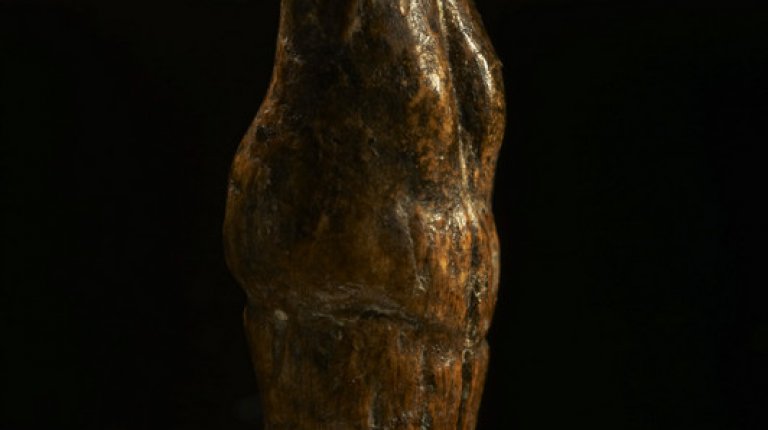
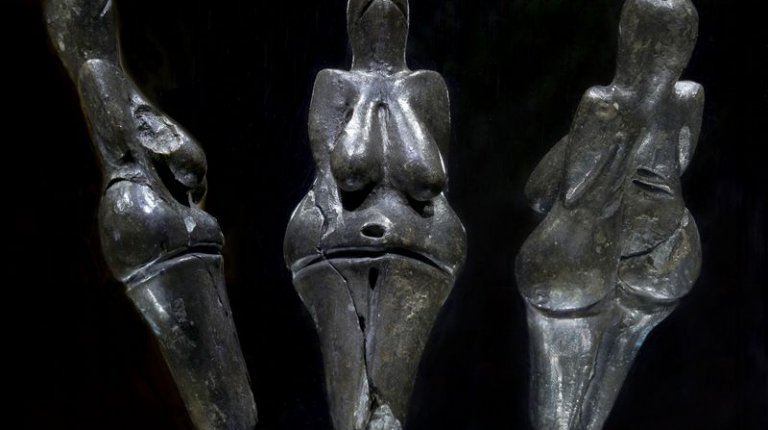
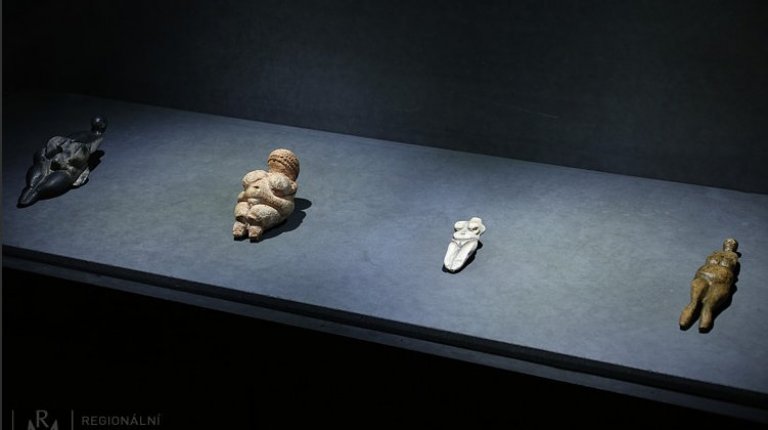
Finds of Gravettian Venuses are distributed all across Europe, from France and Italy through Moravia and out into the East European Plain – for example, the sites at Lausell, Lespugue (→ exhibit 10.5), Grimaldi, Willendorf (→ exhibit 10.6), Dolní Věstonice (→ exhibit 10.4), Pavlov (→ exhibit 10.3), Předmostí (→ exhibit 10.9), Petřkovice (→ exhibit 10.2), Moravany nad Váhom (→ exhibit 10.7), Mezin, Eliseevichi, Avdeevo (→ exhibit 10.8), Gagarino, Kostenki – and a group of female figurines also occur in the sisterly Palaeolithic in Siberia, at the site of Malta. Comparison between them generally reveals a certain similarity in execution and style, which may attest direct relationships between populations thousands of miles from each other. Surprising similarities between Central and Eastern Europe exist particularly within the Upper Gravettian time-frame, for example between the figures from Willendorf and Gagarin, or from Moravany and Kostenki.
Despite the various proportions having changeable dimensions, the impression and message conveyed by these figurines clearly suggest they were created according to the same canon, established on a similar philosophical foundation of Palaeolithic society: the whole figure is worked into a lozenge shape, the upper point of which symbolizes the head, the lower point the feet, and the lateral tips touch the sides of the body; the circle inscribed into the central span of the rhombus delineates the maternal stomach; from the upper edge of the circle are suspended large breasts, while the lower part of the circle is made up of the genitalia. Thus it seems that Upper Palaeolithic artists were portraying a naked woman in the very late stages of pregnancy. Additionally, in the profile of the rhombus we can see the ancient sign of the vulva, so that the figure not only symbolized, but in a ritual could also positively affect, the childbearing and reproductive power of a woman, from which emerged all members of the group and in which they recognized the embodiment of the sexual principle, ensuring the continuation of life.
The head, eyes or facial features were not important, neither were the arms. Instead, the majority of the women’s heads, whether in mammoth carvings or ceramic statues, are variously stylized and reduced to an absolute cipher. At our Gravettian sites we encounter several portrayals of heads: a simple protuberance - sometimes with eyes, but predominantly however with four characteristic depressions on the crown (Venus of Věstonice type), a bicone shape - sometimes almost mushroom-like (at Pavlov this is demonstrated in both ceramic and ivory form), a spherical shape covered in a series of protrusions - resembling grapes or a woven basket (typical at Willendorf but also at Pavlov and at sites in Russia), and a triangle, which symbolizes the head of a geometrically stylized woman in an engraving from Předmostí.
Such reduction, however, does not indicate that these figures were expressions of some personal identity; rather, these human forms should be understood more as anonymous anthropomorphic symbols. The absence of a face can also be explained by the so-called “hunter-style” of Palaeolithic art, which with singular sensitivity invariably stressed the mass of the torso at the expense of head and limbs, even in its depiction of animals. Most experts incline to the view that depicting a specific individual was taboo. Human faces are deformed or caricatured throughout all of hunter art, and parallels for such behaviour are supplied by ethnography.
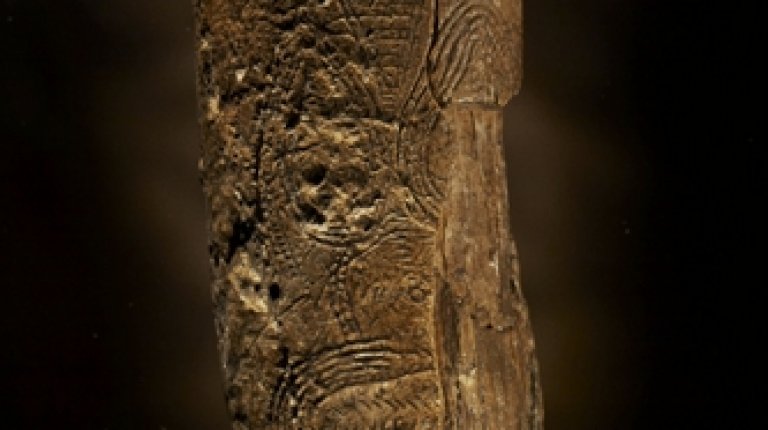
The portrayal of a specific individual appears very seldom in Palaeolithic art. The first evidence in fact comes from the dig at Dolní Věstonice I. It is a relatively realistic face of a woman carved into mammoth ivory, partly stylized into an elongated form culminating in a large hat or hairstyle, with striking facial features and an asymmetrical mouth (→ exhibit 11.1). This head was complemented by a subsequent find of a crudely carved mask with a similarly striking asymmetrical mouth. The specificity of this one individual becomes even more exceptional when compared with the skull of a ritually buried woman at the same site. This skull also bore pathological features that would have caused facial asymmetry (DV 3). Another famous female portrait comes from the French site of Brassempouy, where a miniature carving in ivory was found depicting the head of a young woman with a triangular face and an elongated neck, who is also given a hairstyle – or head covering – decorated with a grid-like pattern.
Another exceptional find represents the torso of a small female figurine and emanates from Petřkovice (Venus of Petřkovice → exhibit 10.2). Its relief of a young slender body is in complete contrast to the full-bodied figures of the other female statuettes. The aesthetic effect of this artefact is underscored by the colour of its raw material, red hematite – perhaps expressing the colour of life, and also the strange “cubist” style of carving.