This successful population extended its area of settlement first into the tropical zone of South Asia and Australia, and then, about 50-30,000 BP, also penetrated in several waves into the cold and dry zones of Europe and Northern Asia.
Their cultures – first Aurignacian and subsequently Gravettian – were not carried with them from tropical Africa, or from the climatically mild Mediterranean. Rather, the culture of these anatomically modern populations, who had migrated in waves along the Danube ever deeper into the heart of our continent, expresses their perfect adaptation to the cold conditions of the new environment into which they had penetrated. Nor can it be ruled out that helping to develop such culture were the indigenous Neanderthals (Homo neanderthalensis), at this point now dying away, but with whom this immigrant population first came into contact and perhaps even shared genes.
Neanderthals represent a developmentally successful although today extinct developmental form of human. The reason for their dying out is not entirely clear; the causes were undoubtedly many, for example a lower ability to compete against modern humans, and above all the fact that they were unable to sufficiently culturally and economically adapt to changed environmental conditions during the course of the last phase of the Ice Age.
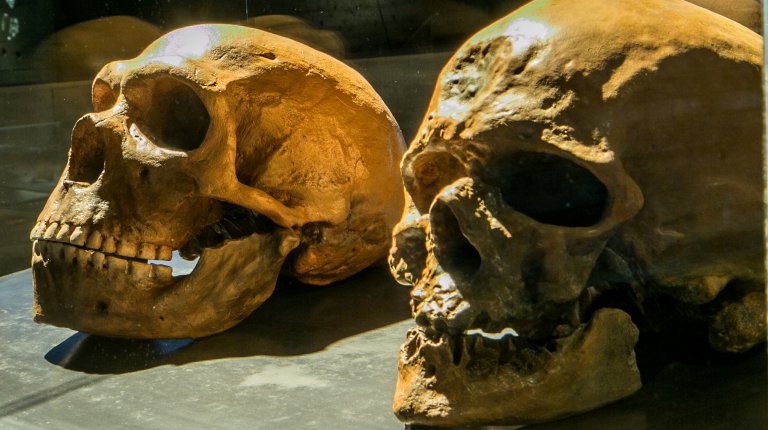
A comparison between their skeleton and that of anatomically modern humans shows us (→ exhibit 4.1) that Neanderthals had a smaller, more muscular and robust figure, with shorter lower limbs and forearms. Average height for males ranged between 160–165 cm and for females 150–155 cm. The skull was more elongated, it had a lower arch with a markedly more protuberant face and a characteristically prominent brow ridge.
The skeleton of an anatomically modern human is taller and more graceful (male about 180 cm and the female about 160 cm). The skull is short and high, with no prominent eyebrow ridge on the frontal bone. The cranial capacity did not essentially increase.
Calendar of ages
On the eastern edge of Dolní Věstonice, in a cliff forming the wall of a clay pit beside the former brickworks, has been preserved the sequence of geological layers dating back to the beginning of the last glacial period. It therefore covers over 110,000 years of fluctuating developments in the natural environment and climate. Most clearly marked in the stratification are the periods of extreme cold and dryness, when icy winds heaped up against the Palava masses of fine dusty material from the exposed surface of the desert-like and eroding low hills for miles around. Along the foot of the Pálava ridge these layers settled as a homogenous, fine-grained light and chalky loess. The cold became most intense in two phases, roughly 65,000 and 22,000 years ago. In the warmer and wetter interstadials the creation of loess was invariably suspended, and soils began to develop on the surface – darker bands whose level of development, micromorphology and colour signify a corresponding warming in the climate.
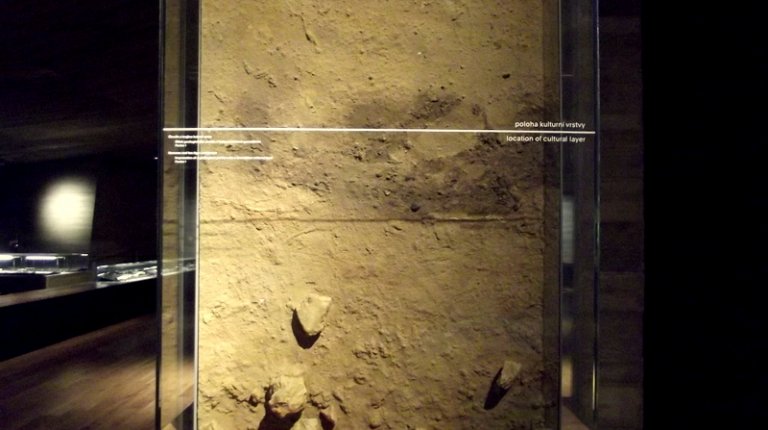
At the base of the wall is a recognisable band of brown forest soil from the last interglacial period (about 110,000 BP); this is overlain by three black bands of steppe chernozem, which correspond to the warmer temperature fluctuations at the boundary between the interglacial and glacial period. The bulk of the face comprises light loess of the culminating glacial period. A light brown layer of soil, not easy to make out, which separates the loess about halfway up its length, indicates a series of temporary warming periods.
The traces of human settlement lie on the interface between this band and the loess overburden above, at a depth of about 6 metres (→ exhibit 4.2). The position of the cultural layers show that the slopes of the Pavlov Hills were only attracting human settlers for a short period of several millennia around the date 30,000 BP. This was at a time when the transient soil creation processes were ending (traces of the Aurignacian) and the deposition of the last monumental layer of loess was beginning (Gravettian). The soils in the subsoil of the cultural layers testify to the fact that humans appeared here whilst conditions were still relatively favourable, whereas the loess in the overburden already documents a cooling in the climate. The 10 metres of deposits in the subsoil and the 6 metres above this thin geological formation have not yielded any further evidence of human presence.
Landscape of the glacial period
Various scientific samples taken from the cliff profile have enabled not just the dating of individual layers or the investigation of their structure, but have also allowed us to look for traces of organisms and plant life that were alive at that time. Applying these methods, we are able to reconstruct the landscape and how it has changed.
Palaeobotanical analyses of the charcoal from wood and pollen grains show that during this period when Dolní Věstonice flourished, the cold and dry climatic conditions were not quite as drastic as previously thought. It is even likely that it was precisely this slight warming, one of many that periodically occurred throughout the glacial period, which facilitated the first waves of migration of modern Homo sapiens to penetrate Europe and establish their culture here.
Huge unbroken ice sheets temporarily retreated northwards to Scandinavia and south to the Alps, leaving an open area of cryophilic steppe and tundra interspersed by islands of woody plants and probably even whole forests. The wide, divergent and meandering flow of the river Dyje was lined with alder and willow; up the side of the Pálava climbed spruce, larch and pine, and only the whaleback of Děvín and the plateau of StolováHill, high above the landscape, would probably have remained bare. On the sheltered and sunlit slopes of Pálava also thrived more thermophilous deciduous trees such as oak, beech and even the hygrophilous yew. This rolling, park-like landscape was also optimal for large herds of animals, since it offered both open space and at the same time sufficient plant nutrition. In general, then, there persisted a relatively favourable climate here, probably even wetter than at the beginning of the Lower Palaeolithic and with a landscape boasting even more forest cover.
Surrounding fauna – prey and predatory competitors
The age of the mammoth hunter is characterized by the huge variety of animal species. At that time the South Moravian landscape was inhabited by many species who have subsequently become extinct (mammoth, woolly rhinoceros), or which now exist only in colder climes (reindeer). Besides these, many other large mammals lived here that still survive to this day, such as the red deer, roe deer, wild boar, brown bear, chamois and Alpine ibex.
Probably it was the large herds of hunted animals in the Danube Plain that first attracted humans to this region of Europe. Mammoth herds congregated in the water meadows and at the water’s edged while the hilly country was criss-crossed with reindeer and horses, similar in appearance to today’s Przewalski’s horse.
The mammoth, up to 5.4 metres long and 2–3.5 metres tall, with its 30-centimetre-long brown hair, 2-centimetre-thick hide and a fat layer 10 centimetres deep, was well adapted to the environment during the glacial period. Judging by the behaviour of modern elephants, a 10-member family of mammoths with sufficient food and water could inhabit a territory of approximately 10–70 km2 in area, although during migration herds of perhaps hundreds of individuals passed beneath the Pálava. Herds of mammoth, reindeer and horses represented the main source of meat (fat and protein) in the human diet. Bones, teeth, skin and other organic raw materials subsequently served not only to make tools, but were also used in the construction of dwellings.
This main source of nourishment and livelihood was also supplemented with hunting bison (aurochs), woolly rhinoceros and other animals of the steppe. Early analyses of isotopes from human bones are indicating that their diet was relatively varied, which matches the bone record found at settlement sites. Mammoth hunters did not turn up their noses when it came to eating much smaller creatures such as hares, whose bones in some places are found in abundance, and to a lesser extent also birds and fish (providing their delicate remains were preserved); the bones of foxes are also common, as are those of wolf, both of which also provided invaluable pelts for making clothes and covers. Around the settlement would naturally also appear dangerous predators and competitors in the hunt: lions, hyenas and bears would all have to be driven away or killed.