The anthropological finds from Dolní Věstonice and Pavlov are labelled with Arabic numerals (in contrast to the Roman numerals used to label the sites). The complete finds catalogue for the Dolní Věstonice site so far contains 64 items, and the Pavlov site contains 33. Besides the bones of individuals ritually buried in graves (six complete skeletons – Dolní Věstonice 3, 13–16 and Pavlov 1; for more details see the List of Complete Skeletons), other minor fragments of human bone and individual teeth have also been documented. One of the most recent finds were the bones of two human hands that were interred together at the Pavlov I settlement. If this find has not emanated from graves subject to natural disturbance (carrion eaters, geological processes etc.), it may be evidence of a different approach to the dead and also, perhaps, social differentiation within society.
In 1949, at Dolní Věstonice I the skeleton of a woman was found in an extreme crouched position, in 1957, there followed the discovery of a man buried in the area of Pavlov I, while in 1986 and 1987 at Dolní Věstonice II were excavated the famous triple burial of three young people and the grave of an older man buried beside a hearth in the middle of a hut
.
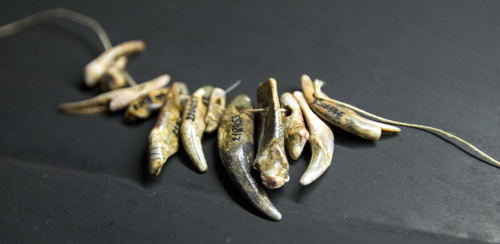
Although the dead in Věstonice were buried with care, the equipment supplied to them on their journey to the afterlife was rather modest. Around the skeletons, especially around the skulls, were found the perforated teeth of predators (→ exhibit 9.2) and small pearls carved out of mammoth ivory, which were used as a decoration on clothing - headgear in particular. In contrast, taking into consideration the personal ornaments freely scattered around the settlements, we assume that people in life were more richly adorned. The skull and occasionally also the pelvis of the deceased are sometimes covered in a red dye (for more details see Use of Mineral Pigments).
In some cases, it seems that the positioning and gesture of the buried corpse, the items found in its immediate vicinity and certain wounds, where they are visible on the bones, may have symbolic significance.
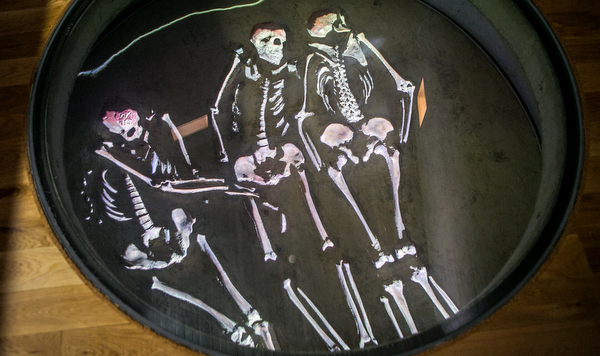
At Dolní Věstonice II, the three young people were lying in a manner giving the impression that the young man on the left was pouring some colourful dye into the lap of the central individual – his hands are deliberately placed on the pelvis of the central figure, who according to the latest Palaeogenetic analysis is also male. The last of the buried bodies, the young man on the right, lay face down (→ exhibit 9.1)
In addition, there exists a connection and parallel between the graves and certain symbols; for example, between the grave of the “Woman of Věstonice” (Dolní Věstonice 3), whose asymmetrical face – caused by a pathological condition - echoes the miniature carved ivory head of a woman found at the same site, among whose carefully engraved facial details is a mouth that has been outlined in similarly crooked manner (→ exhibit 11.1).
The positioning of bodies in Palaeolithic rituals still does not conform to any stable or binding pattern – it is not dependent on age, sex or the importance of the deceased. The dead were arranged in a recumbent position on their backs, side or front and with a very marked flexing of the limbs, sometimes bent to such a degree that the body must have been buried after it had begun to decompose, several months after death. Apparently, only in exceptional cases in Europe was cremation also used, as it was for example at the child’s grave at Dolní Věstonice (grave DV 4).
Digging grave pits was generally quite unusual in Moravia, even though here, just as elsewhere, it was necessary to protect the body against carrion eaters and the effects of the weather. Archaeological records show that there were a variety of methods employed to protect the body – using mammoth scapula (grave of the woman Dolní Věstonice 3 or of the man Pavlov 1) and stone or wooden structures (probably the triple grave DV 13–15). The man whose remains were found at Dolní Věstonice (grave DV 16) was, according to the overall interpretation of the excavated area, interred inside a hut, close to a hearth whose heating capacity had been additionally prolonged with the help of added limestone blocks that functioned as thermal batteries.
Nonetheless, no protection over the grave could prevent it from subsequently being disturbed by geological processes, were they to affect the entire site. Bodily remains could also, however, be disturbed prior their interment, for example, when the hunter died in the middle of winter and digging the grave pit would have been especially difficult. The surviving members of the group would certainly have had to consider whether to sacrifice one of their dwellings to the dead. Thus a provisional burial may have been the solution, with a definitive inhumation of the already disturbed remains taking place in the spring.
It is difficult to say whether any of those individuals interred here played an important role in the community, possibly as a chieftain or shaman. The role of shaman is occasionally attributed to the woman from Dolní Věstonice with the crooked face; more arguments for inhabiting such a role have been posited in favour of the enigmatic central figure from the triple grave. His central position, the disease he evidently suffered during his lifetime, and his outwardly sexual indeterminacy, which today in some fourth-world nations is not simply regarded as a disability, but also at the same time as a special gift – a source of power and strength, could all point to him holding such an exceptional position.
Also connected with ritual ceremonies are the finds of human skull fragments, chipped into a purposefully required shape, which may be interpreted as ritual goblets. Two such finds came from the excavation of Karel Absolon at the Dolní Věstonice I site (DV 1 and DV 2; were destroyed during the fire at Mikulov Castle); another skullcap (or calvarium) was discovered by Bohuslav Klíma at the Dolní Věstonice II site (DV 11). It is interesting that these “goblets” were found not far from the ritual graves (DV 3 and DV 13–15).
Use of Mineral Pigments
Closely connected with the burial rites of the Gravettian hunters is the use of red pigment, which is often applied to cover the skull and sometimes the pelvis of the dead, for example in the triple grave (DV 13–15) or indeed in the burial of the man at the Dolní Věstonice site (DV 16), where beside him was also found a fragment of a spreading slab with traces of pigment. Use of pigment in connection with burial practices undoubtedly had ritual significance – possibly as a symbol of blood or life. However, in the case of settlements more generally, it cannot be ruled out that use of pigment fulfilled a straight-forward aesthetic or practical function – powder for the floor of a hut, a coating of pigment as protection against insects or when processing hide.
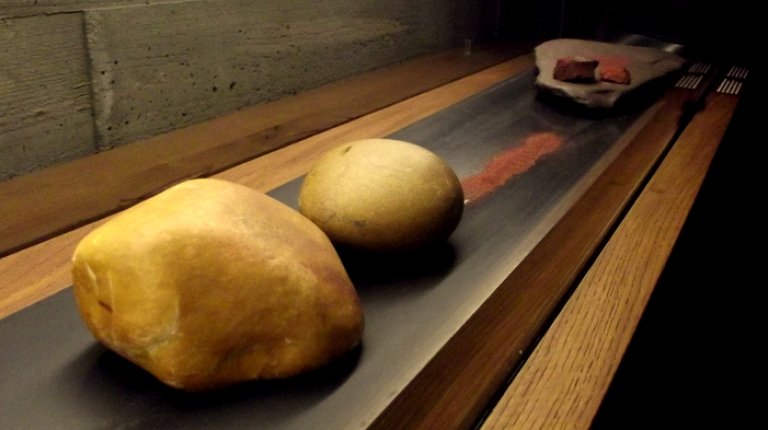
Lumps of various pigments represent relatively abundant finds at Gravettian site; here in Moravia they are mainly mineral ores – red, ochre or yellow in colour . At the sites Dolní Věstonice I and II, and Pavlov I, there exist contexts in which gobbets of red or yellow pigment are gathered together with the stone slabs and grinders to process them (→ exhibit 9.4). Pigment is manufactured by grinding such gobbets of pigment using grinders (cobbles) on stone slabs and subsequently mixing the powder with water or animal fat. Comparing the streaks produced by randomly selected lumps of pigment has revealed at least eight shades of colour - a surprisingly varied palette.
List of Complete Skeletons
Dolní Věstonice 3, site DV I – upper part. Woman, 36−45 years old, height 158−159 cm, minimum weight 56 kg, lying in a crouched position on her side, northwesterly orientation, with red pigment on skull and upper part of body; around the body were deposited ten perforated fox teeth.
Dolní Věstonice 13, site DV II – the top. Male, 21−25 years old, height 168−169 cm, weight approx. 65 kg, lying on the left of a triple burial, on his back, slightly crouched towards DV 15, south-southwesterly orientation, pigment on skull, with twenty perforated predator teeth and mammoth ivory pendants.
Dolní Věstonice 14, site DV II − the top. Male, 16−20 years old, height 179−180 cm, weight approx. 68 kg, lying on the right of a triple burial, on his front, southerly orientation, pigment on skull, with three perforated wolf cuspid teeth and mammoth ivory pendants.
Dolní Věstonice 15, site DV II − the top. Sexually indeterminate individual, 21−25 years old, height 159 cm, weight 66−68 kg, lying in the centre a triple burial, on his back, southerly orientation, pigment on skull and pelvis, with four perforated fox cuspid teeth.
Dolní Věstonice 16, site DV II – western slope. Male, over 45 years old, height 171 cm, weight 68−69 kg, lying in a crouched position on his side beside a hearth, easterly orientation, pigment on skull and pelvis, with four perforated fox teeth.
Pavlov 1, site Pavlov I – north-west. Male, 36−45 years old, height 172−178 cm, weight approx. 70 kg, originally lying probably in a crouched position, although subsequently pulled apart by subsidence of the slope.