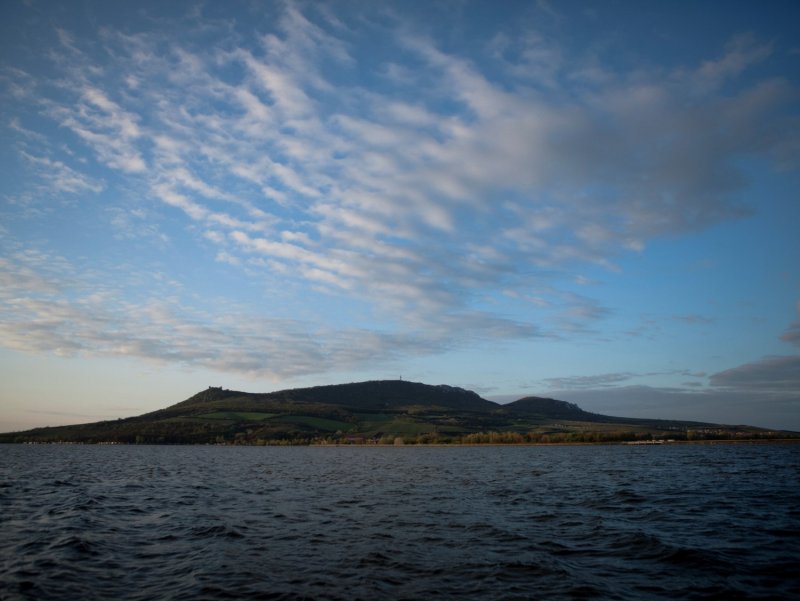
A system of settlements in strategically suitable locations, generally controlling river valleys is characteristic. Today, in the municipalities of Dolní Věstonice, Pavlov and Milovice we differentiate an entire complex of such settlements, roughly the same age and linked internally according to a certain functional key. Their situation is arranged so as to optimize the strategy for hunting herd animals. They create an uninterrupted chain stretched out along the northern and north-eastern lower slopes of the Pavlov Hills. From the prominent peak upon which today stand the ruins of Děvičky Castle, you can observe all the locations of the former settlements; and conversely, from all these sites can be seen Děvičky, which could in the past have also served for long-range optical signals when co-ordinating the hunt. The majority of the settlements follow the gentle undulations of the terrain at the same altitude of 200 m above sea level, which gave a good view of animal movements in the valley bottom about 30−40 metres below, as well as control over the side ravines and valleys, running against the slope, into which animals could ideally be driven and slaughtered. The only Gravettian settlement not conforming to this model is our latest, at Milovice IV, which lies at the centre of the village, almost at the level of the river meadow and whose position blocks access to the lateral Milovice valley.
The individual sites in the Dolní Věstonice – Pavlov – Milovice area have their own hierarchy, conferred partly by size and partly by the complexity of activities that can be established for the location. The large, complex settlements of Dolní Věstonice I and Pavlov I cover areas whose dimensions are in excess of one hundred metres, and are scattered with the remains of repeatedly used hearths and built huts, rubbish sites from the consumption of food and manufacturing activities, traces of ritual activities, as well as the individual graves of the hunters themselves. We can assume that both these locations fulfilled their functions year-round. Also ample in size is the settlement Dolní Věstonice II, bigger even than the two mentioned above, although traces of settlement are not as intensive here, being more spread out across the area and, when calculated together, occupying a much longer time frame (although continuity is repeatedly interrupted). This site is celebrated primarily for its anthropological finds, which include the triple burial, the grave of a single male and a quantity of scattered human skeletal fragments in and around the area. Milovice I also occupies a large site, though much of the space is dominated by a large midden of mammoth bones. The site was probably resettled at certain intervals. The other sites (Dolní Věstonice III, Pavlov II) are smaller, measuring in the tens of metres at most and were probably occupied seasonally. The newly discovered site of Pavlov VI represents practically the only settlement unit with “kitchen” equipment for meat processing, and also contains remnants of animal bones. Some of the larger sites arose precisely through the accumulation of such units.
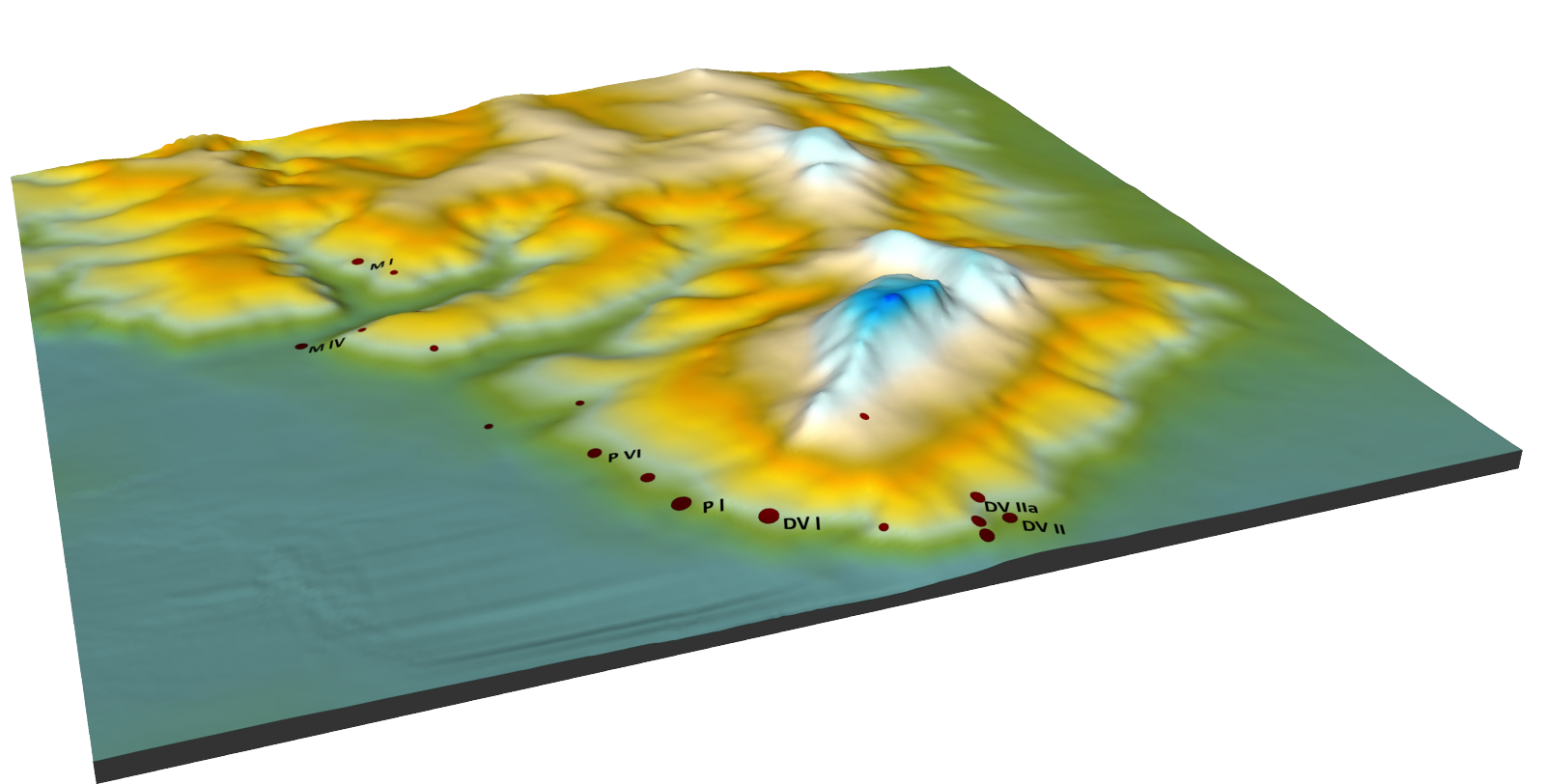
Brief overview of archaeological sites: position and excavation directors
Dolní Věstonice I (Absolon´s Station): National Cultural Monument. A complex of Gravettian settlements and mammoth midden located on the sweeping slopes of the vineyards across the eastern edge of the cadastre. In the central and upper sections have been traced separate settlement units (huts). Altitude: 200–235 m. Excavation: Karel Absolon (1924-1938), Assien Bohmers (1939-1942), Karel Žebera and team (1945-1946), Bohuslav Klíma (1947-1952, 1966, 1971-1979), Jiří Svoboda (1990, 1993).
Dolní Věstonice II (locations: Cihelna, Nad cihelnou, Pod lesem): National Cultural Monument. A complex of Gravettian settlements at the eastern edge of the village, which stretch from the “Calendar of Ages” across the terraced terrain of the crown of the hill and the western slope up to the field beneath the forest (site IIa). Within this area are distributed individual settlement units (huts); in the lateral ravine beside the site is an adjacent mammoth midden. Altitude: 200–250 m. Excavation: Bohuslav Klíma (1959–1960, 1985–1988), Jiří Svoboda (1985–1991, 1999, 2005); site IIa – Emanuel Dania (1933), JiříSvoboda and team (1999, 2012).
Dolní Věstonice III (location: Rajny): Individual Gravettian settlement units (and probably Aurignacian, too, in the subsoil) lie on a steep slope planted with vines between sites I and II. Surface finds also continue across the field towards the forest (these are evidently Aurignacian). Altitude: 215–290 m. Excavation: Bohuslav Klíma (1969-1970), Jiří Svoboda (1993, 2012), Petr Škrdla (1994–1995).
Pavlov I National Cultural Monument. Intensively occupied Gravettian settlement in two large concentrations in a field adjoining the village from the west. Settlement units (huts) primarily cover the south-east section, where their ground plans create a difficult to decipher palimpsest. Altitude: 190–205 m. Excavation: Bohuslav Klíma (1952–1965, 1971–1972), Jiří Svoboda and team (2013-2015).
Pavlov II Smaller Gravettian settlement at the eastern edge of the municipality, now gradually being built over by new houses. Altitude: 205–215 m. Excavations: Bohuslav Klíma (1966–1967), Jiří Svoboda and team (2009-2010).
Pavlov III Sporadic stone tools and bones of the Gravettian in the wall of a former, today back-filled clay pit beside the Pavlov-Milovice road. Altitude: 180 m. Excavation: Bohuslav Klíma(1966, 1977-1980).
Pavlov IV Surface finds of stone tools in the valley skirting the south-eastern edge of the village. Altitude: 210–250 m. Continuous surface surveys: Bohuslav Klíma, Jiří Svoboda.
Pavlov V (location: Děvičky): Surface finds of stone tools beneath the castle. Altitude: approx. 360 m. Continuous surface surveys: Bohuslav Klíma, Antonín Přichystal.
Pavlov VI Isolated, completely preserved Gravettian settlement unit at the eastern edge of the village beside the road to Milovice. Altitude: 215 m. Excavation: Jiří Svoboda and team (2007).
Milovice I (location: Mikulovsko nad silnicí): Complex of settlements and mammoth middens in the valley to the south of the village, along the road to Mikulov. In the subsoil of the Gravettian runs a weaker Aurignacian layer. Altitude: 230–240 m. Excavation: Bohuslav Klíma (1949, 1986), Martin Oliva (1986-1991).
Milovice II (locations: Waldfleck, Marktsteig): Surface finds of stone tools on a small ridge to the north of site I. Altitude: 220 m. Continuous surface surveys: Court Councillor Beigl (1927), Bohuslav Klíma (continuously), Martin Oliva (1988), Alexander Verpoorte and Marián Žemla (1999).
Milovice III (locations: Brněnský, Strážný kopec): Sporadic finds. Altitude: 220–265 m. Continuous surface surveys: J. Lavický (1930s), Bohuslav Klíma (1984), Jiří Svoboda (1985), Martin Oliva, Alexander Verpoorte and Marián Žemla (1999).
Milovice IV (built up area of the village): Gravettian settlement, probably extensive, beneath the structures of the contemporary village. Altitude: 180 m. Excavation: Jiří Svoboda and team (2009-2010).