Stone raw material for the manufacture of knapped artefacts
Material: stone – flint (erratic silicate), radiolarite
Exhibit type: original
Archaeological site: Pavlov I (Pavlov near Dolní Věstonice, Moravia)
Core
Material: stone – flint (erratic silicate)
Exhibit type: original
Archaeological site: Dolní Věstonice II (Dolní Věstonice, Moravia), Předmostí I (Předmostí u Přerova, Moravia)
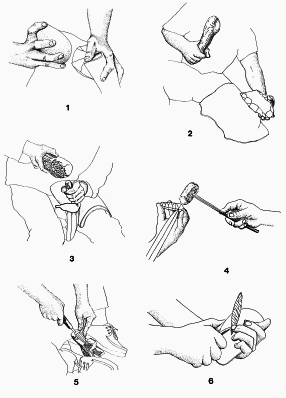
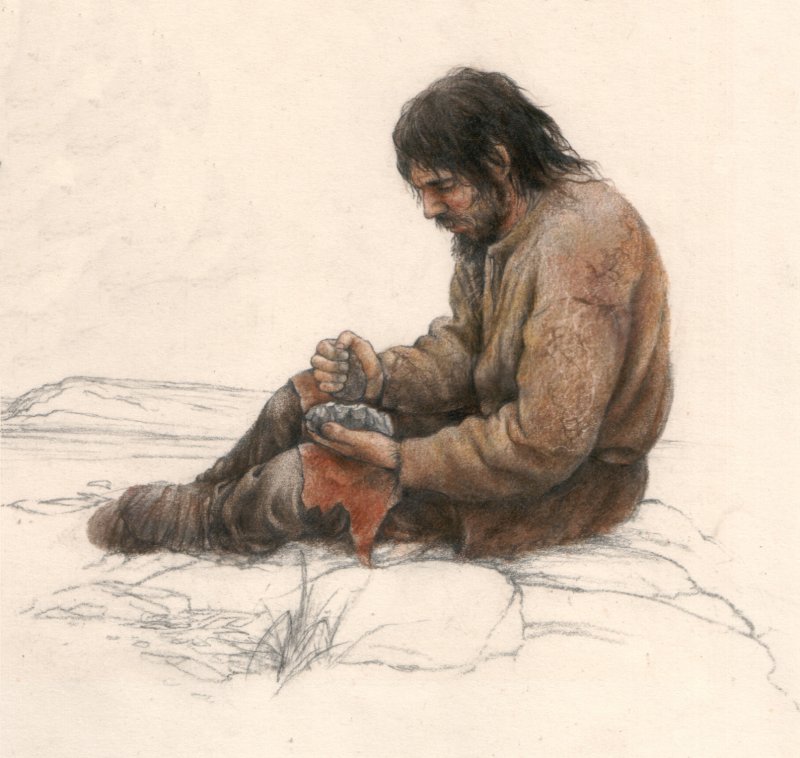
By chipping off surface flakes, the raw material was fashioned into the shape of a core, from which in the next phase were removed regularly shaped flakes or blades. In the Upper Palaeolithic, these came in a variety of sizes and were typically square-like or pyramidal in shape, with a characteristic leading edge. As the core was worked, its size was gradually reduced until it was entirely exhausted – the only remnants being core residues and various microcores.
Hammerstone
Material:stone
Exhibit type: original
Archaeological site:Pavlov I (Pavlov near Dolní Věstonice, Moravia)
To strike off a flake or blade and also for making other modifications, either a hammerstone could be used (hard hammer), or an antler or bone tool (soft hammer). A core residue could also be used as a hammerstone.
Blades
Material:stone – flint (erratic silicate), radiolarite
Exhibit type: original
Archaeological site:Pavlov I (Pavlov near Dolní Věstonice, Moravia), Dolní Věstonice II (Dolní Věstonice, Moravia)
The knapped off blades and flakes could either be used straight away as a functional tool (e.g. for cutting), or could be further reworked, especially by delicate retouch of the edges (by knapping off scale-like microflakes) to create various types of tool.
3D jigsaws – lithics refitted to the shape of the original core
Material: stone – radiolarite
Exhibit type: original
Archaeological site: Pavlov I (Pavlov near Dolní Věstonice, Moravia)
Reassembling or refitting used or disposed of lithics back into the shape of their original cores enables us to reconstruct the technological approaches of manufacture in the stone industry.