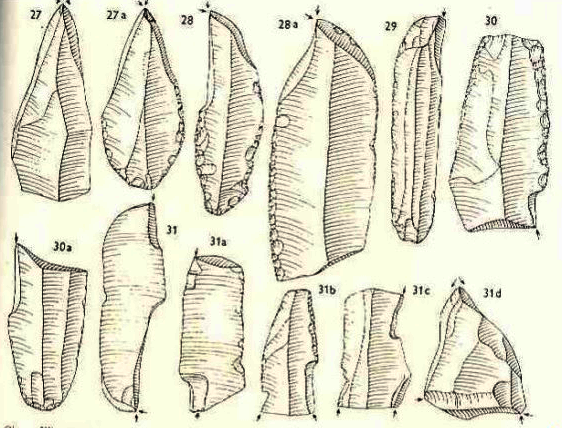
Burins
Material: stone – flint (erratic silicate)
Exhibit type: original
Archaeological site: Pavlov I (Pavlov near Dolní Věstonice, Moravia), Dolní Věstonice II (Dolní Věstonice, Moravia)
Burins were a tool characteristic of the Upper Palaeolithic, and were primarily used to carve or engrave bone. They were made a using a percussive blow (a so-called “burin blow”), struck at an angle to the transverse edge of the tool, to create a sharp working tip. These tips can be classified according to the site of percussion (dihedral,on lateral retouch,angel, transverse) or by the overall character of the tool (arched, fluted, flat).
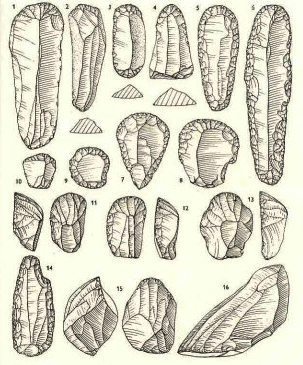
Endscraper
Material: stone – flint (erratic silicate), radiolarite
Exhibit type: original
Archaeological site: Pavlov I (Pavlov near Dolní Věstonice, Moravia), Dolní Věstonice II (Dolní Věstonice, Moravia)
Scrapers are another tool that typify the Upper Palaeolithic. They could be used for various purposes, in particular for processing leather and hides, but also wood or bone. They were made mostly on blades, but also on flakes or cruder fragments by working the end part into a characteristic, mainly arch-shaped retouched head. Depending on their shape, size or type of tool base used, scrapers can be classified as blade, flake, carinated and convex scrapers etc.
Sidescraper
Material: stone – chert
Exhibit type: copy of original (plaster)
Archaeological site: Pavlov I (Pavlov near Dolní Věstonice, Moravia)
Collection: Institute of Archaeology of the CAS, Brno v.v.i., Czech Republic
The side scraper is a cruder, more massive type of scraper. It is manufactured from a flake, with a working edge on one side created using intensive retouching.
Retouched blade
Material: stone – flint (erratic silicate)
Exhibit type: original
Archaeological site: Dolní Věstonice II (Dolní Věstonice, Moravia)
A retouched blade represents the most commonly occurring Upper Palaeolithic tool. It had a one or both lateral edges sharpened along its entire length by fine retouching, and was generally used as a knife.
Points
Material: stone – flint (erratic silicate)
Exhibit type: original
Archaeological site: Pavlov I (Pavlov near Dolní Věstonice, Moravia), Dolní Věstonice II (Dolní Věstonice, Moravia)
Besides the characteristic backed points with one side blunted by abrupt retouching (exhibit 5.2), also occurring in the Gravettian are more simple blades which have been retouched down to the tip, easy enough then to adapt into typical beak-shaped points.
Microliths
Material:stone – flint (erratic silicate), radiolarite
Exhibit type: original
Archaeological site: Pavlov I (Pavlov near Dolní Věstonice, Moravia), Dolní Věstonice II (Dolní Věstonice, Moravia)
Typical for the Moravian Gravettian were tiny microlithic tools, generally referred to microliths. One commonly shared feature is blunting along one side, but otherwise – morphologically and typologically – microliths are extremely varied. They include tiny backed micro-blades, microlithic points, microsaws (microblades with a serrated edge created by retouching), geometric microliths (triangles, trapezoids and half-moons) and an entire range of interim shapes. They were used in many different ways, and were probably set in continuous rows onto a wooden or bone handle, or the shafts spears and harpoons. By combining variously shaped microliths, it was possible to create very complex types of point, or specialized tools that would otherwise have been impossible to manufacture.